

A Message from our Rector
On this rock
“And I tell you, you are Peter, and on this rock I will build my church, and the gates of Hades will not prevail against it. I will give you the keys of the kingdom of heaven, and whatever you bind on earth will be bound in heaven, and whatever you loose on earth will be loosed in heaven.” Matthew 16:17-19
Reading the Gospel passage for August 3 brought up memories from seminary and how I learned the importance of knowing not just the surface meaning of words in the Bible, but the layers of meaning and usages-in-practice of those words. “Binding and loosing” is one such example. I share this memory with you so that you can see one aspect of the biblical basis for the Episcopal Church’s stand on human sexuality.
When Jesus names Peter the “rock”—the rock on which the church would be built—Jesus says to Peter, “Whatever you bind on earth will be bound in heaven, and whatever you loose on earth will be loosed in heaven.” “Binding” and “loosing” had a very specific reference for Jews in Jesus’ time—and understanding their implication has been vital for the Christian tradition ever since. These words refer to the process of adjudicating a specific case governed by a general law in the Bible. For instance, we all know that one of the Ten Commandments is “Thou shalt not steal.” But is it stealing if a man finds a dove on the street? What if there is a person who lives on the street who keeps doves for his livelihood?
Legal scholars in ancient times decided that if the dove was CLOSER than (for example) 50 feet to the dove cote when it was found, the dove would belong to the owner of the dove cote. In this case, the law against stealing is considered binding.
But if the dove was FURTHER than 50 feet from the dove cote, the dove would belong to the man who found it. He would not be charged with stealing the dove—in fact, he could keep the dove. In this case, given the context and circumstances, the law against stealing is loosed.1
“Binding and loosing” refers to the work of the scholars, legal experts, and leaders to decide how general rules apply in lived situations. A general law must always be applied to circumstance, context, and practices. Moreover, as knowledge and understanding change over time, there are new considerations to apply to legal questions, and laws were loosed or bound accordingly.
There is a throughline: living in the way preached through the Bible and especially by Jesus in the Gospels, a way that brings God’s kingdom of love and inclusion. This throughline guides us even as understanding of the Bible and social practices change through time. We are not merely “changing with the times.” We bring fresh information to a question about how we can best bring about God’s kingdom.
An excellent example of this is the radical shift in understanding the practice of human beings owning other humans. Slavery was normal in the ancient world, and it existed across the globe right up to the beginning of the 20th century. The Bible never says that the institution of slavery is evil. The law that Jesus lived by and the law codes that Christians created later included guidance on how to treat and value slaves, but never questioned the institution of slavery. But today, there is virtually universal agreement among Christians that slavery is not only wrong, but a terrible evil that must be fought as part of our Christian duty. How did this happen? Abolitionism is not found in the Bible, and slavery is not condemned there. The change can be understood by the impact of the on-going practice of “binding and loosing.”
In the 18th century, attitudes toward slavery changed in Europe and America. Encounters with new peoples, historical events, philosophical and theological developments including the Reformation cast slavery in a new light. Although “binding and loosing” were not terms used in the abolition movement, that is essentially the practice that was employed to completely reassess an institution that was taken for granted in the Bible.
*The throughline was the biblical admonition that a human being is created in the image of God and has value;
*the new understanding was that people of different color and culture are as fully human as white Europeans and that individuals must be able to control their own destiny and decision making as a free agent in response to God.
The throughline and the new understanding about human beings led to the abolition movement and the church’s condemnation of slavery. Even though slavery is a part of everyday life throughout the Bible and not criticized per se, the church undid—loosed—the assumption that human beings can own other humans.
A similar shift has occurred in our time with the question of human sexuality.
In seminary I took a course with Mark Allen Powell, one of the world experts on the Gospel according to Matthew. Prof. Powell was also the expert who helped the Lutheran Church in the United States understand the parameters of a Biblical reassessment of the question of ordaining gay, partnered clergy. Pointing to the Gospel-given responsibility of the church to bind and to loose, Powell noted first the long history in Christianity that condemned same sex behavior. But Powell also noted that given new information and context, it was the church’s prerogative and responsibility to consider loosing the prohibition, pointing to several issues of contemporary context that have changed our original understanding:
• Biblical scholarship has demonstrated that the seven specific interdictions against homosexuality found in the Bbile are highly specific and are not relevant to considering two persons in a loving and covenanted relationship. For instance, Deut. 23:17-18 is a reference to sex workers who are involved in Canaanite fertility rites and temple prostitution and the fear that these practices were infiltrating Jewish practice; scholars have deemed that 1 Corinthians 6:9 is not a condemnation of same sex practices per se, but a condemnation about sex for hire.
• Scholarship, especially in fields of psychology and evolutionary biology, has shown that same sex attraction is not a choice or a perversion, but is a part of an individual’s essential make up—and that it is found throughout human communities and the natural world.
• Loving same-sex relationships became legally possible—and public—in the 20th century. In the ancient world, there was no such thing as a same sex couple who committed their lives to each other through covenantal vows that were recognized socially and legally. In the late 20th century this changed; we now have domestic partnerships and marriage recognized by the state.
Through conversations and study that embody the essence of binding and loosing, the church determined that the crux of commitment is not the sexuality of the two partners but the types of promises being made between two persons, whatever their sexuality. Marriage is a sacrament that models the self-sacrificing love of Jesus, and that makes the love between two people a seed that can be nurtured in a covenantal partnership like marriage and then extended to the wider world. Such relationships do not have to allow for procreation (in that case, older people would be barred, as would those unable to procreate because of physiological problems). Restricting a blessed union to a heterosexual couple and restricting the role of clergy to heterosexuals has been changed. This is the church’s prerogative and responsibility in the face of new information and a changed context. What has been bound is the covenantal and exclusive commitment. Whether the couple is same sex or opposite sex has been loosed.
It is a great and grave responsibility that Peter was given and we have inherited. The scripture and our responsibility to live the life Christ teaches us are gifts of God that we must treasure to the glory of God and for the love of neighbor.
Jen+
1If you would like to read a thorough explanation of the seven “clobber verses” and their more nuance and accurate meaning (compared to their appearance on protest posters), the blue pamphlet Homosexuality and the Bible by Walter Wink is very helpful. They are stacked in the window well of Hamilton Hall—feel free to take some.
Connect With Us

Rector’s Office Drop-In Time
Rev. Jen has set her office drop-in day as Wednesday of each week from 9:30 – 11:30 a.m. and 1:30 – 3:30 p.m. for anyone who would like to stop in and visit. You are always invited to make an appointment for a time convenient for you. Mondays are her Sabbath day.

The Fifteenth Sunday after Pentecost
In-Person Sunday Morning Prayer Service, September 6, led by Seminary Intern, Meghan McConnell, 10:15 a.m. You can stream the service via St. Andrew’s Episcopal Church, Greencastle, Indiana Facebook Page. Click on this link to view the Live Stream. We will start the Live Stream 5 minutes prior to the start of the service.
Click here for the service booklet for this service.
One License #A-741864
CCLI License #22315781
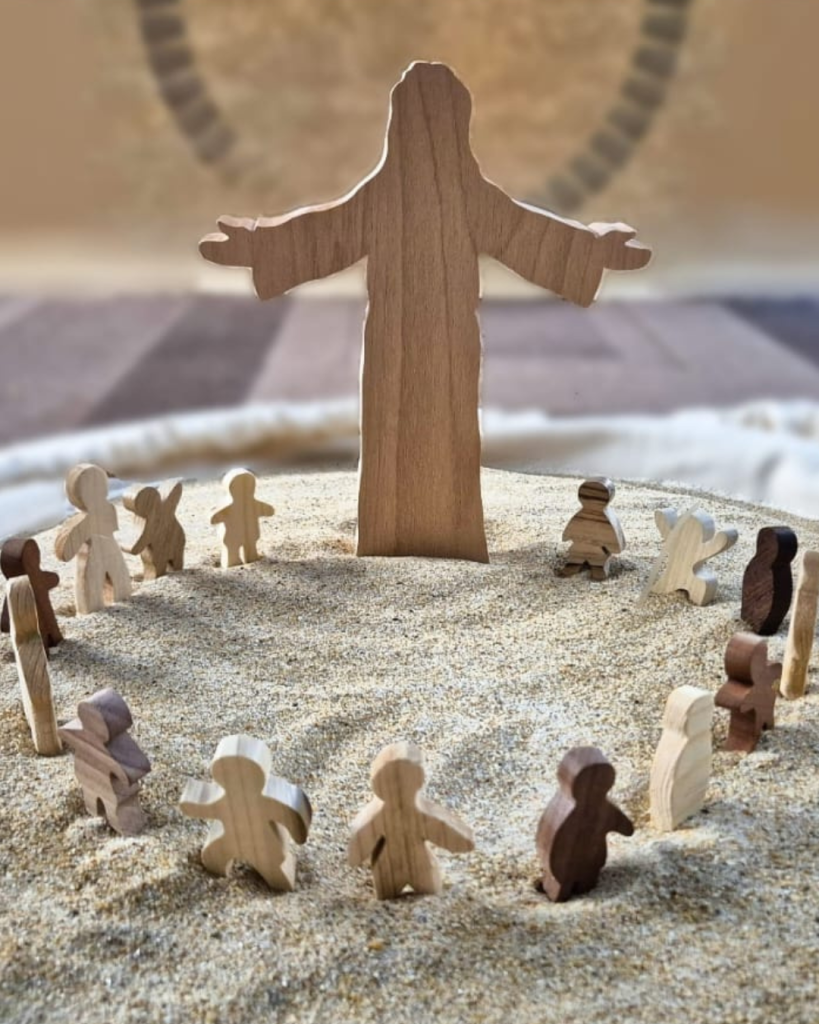
Godly Play Lessons
We are restarting our monthly Godly Play lessons for children of all ages. We are planning on lessons the final Sunday of the month with working around holidays towards the end of the year.
Godly Play is a Montessori-based spiritual formation method that teaches children the language of Christian faith through storytelling, wonder, and play. We tailor the lesson and message based on the children present any given Sunday. If time allows and it fits the lesson, we also often work on craft projects.
Godly Play lessons take place upstairs in the Murray Suite of Hamilton Hall during the first half of the service. The children start the service in Hamilton Hall and then will come into the service usually during the peace.
Here are the dates for the remainder of 2026
- September 27
- October 25
- November 22
- December 20

The Latest Updates
Mark your calendars–Lake Eucharist Sept 20
Our annual Lake Eucharist (and Awesome Potluck Brunch) on Raccoon Lake at the Jedeles’ lake house is scheduled for September 20th, rain date September 27. The service will be begin as usual at 10.15, but hospitality will be more expansive than usual, both in terms of food offerings and entertainment. Bring your sunhat, folding chairs, and swimsuits!
Everyday Experience is Divine Revelation: Learning to Pray
Tuesdays, 4.30 pm, September 15-October 14
For four Tuesdays at 4.30 beginning September 15 we will meet to discuss and practice the examen prayer as described in Sleeping with Bread Holding What Gives You Life by Dennis Linn, Sheila Fabricant Linn, and Matthew Linn (Paulist Press, 1995). We will spend four sessions learn the prayer practice and putting it into action. Dennis, Sheila, and Matthew Linn show how a quiet five minute practice of assessing each day can become a powerful tool for discernment, connection with God, and guide us to living our calls faithfully. Jen+ will form groups at other times for those who request it.
PRAYERS FOR OTHERS
If you have prayers that you would like offered on Sunday–prayers of thanksgiving, for those in trouble or sickness, or those who have died and those who grieve, please call in or send an email to Michelle. The names will be said aloud on Sunday for four consecutive weeks and then cycled off. If you would like the prayers continued, please tell Michelle and the names will be added to the long-term prayer list.
HYMN NAMES IN THE BULLETIN
In the coming weeks, you may notice a change in the way that hymns are designated in the service bulletin. The information at the bottom of the hymn includes a hymn name in capital letters. The hymn that begins “Jesus Christ is risen today” is set to the tune Easter Hymn. The tune for “Come, Thou Fount” is Nettleton. “Let all mortal flesh” is set in our hymnal to the tune Picardy, and both “Love divine, all loves excelling” and “Alleluia! Sing to Jesus” are set to Hrfrydol.
Our reasons for this change are simply pragmatic: the hymn names are shorter than the first lines, and fit better into our bulletins. But there is also a certain skill—and pleasure—to identifying tunes as well as words, in part because it highlights the artistry of the person who wrote the music. Be sure to look this week for this new feature to our bulletins.
BOOK AND BIBLE GROUP– ***on a break until after summer***
We will be taking a break through the summer from our Tuesday afternoon gatherings. Keep your eyes peeled for announcements for occasional gatherings of Pub Theology when we will gather to share snacks, a cold drink, and conversation. Evening Prayer will still be celebrated at 4.00 pm on most Tuesdays.
EVENING PRAYER
Join us for Evening Prayer in the sanctuary on Tuesdays at 4:00. Evening Prayer is a wonderful service to wind down the day and move into the evening hours.
CONTEMPLATIVE PRAYER
On Wednesdays at 1:00, we gather for about a half hour in quiet contemplative prayer. A leader introduces the prayer and a bell is chimed; we sit in prayer for twenty minutes until another chime sounds and then close with a spoken prayer. Feel free to come in any time between 1:00 and 1:20 to pray in silence in a lovely sacred space.
ALTAR FLOWER CALENDAR
An altar flower calendar is posted in Hamilton Hall. Sign up to sponsor the altar flowers to commemorate a birthday or anniversary, remember a loved one, or in thanksgiving for an important event. We ask a donation to help offset the cost of the altar flowers and other worship expenses. Be sure to tell the office your dedication so that it can be printed in the bulletin. Please make checks payable to St. Andrew’s Episcopal Church and in the memo field please put this information: Altar Flowers, person’s name, occasion, Sunday date you’d like for the flowers to be on the altar.
VESTRY MEETING MINUTES
If any of you are interested in what your Vestry is doing, there are two copies of each month’s minutes on the music stand in Hamilton Hall. Feel free to read and return!
SHOPPING LIST FOR NON-FOOD PANTRY
Please see the Non-Food Pantry Latest section of the newsletter for items most in need for this month. Meals and conversation in Hamilton Hall are going well. Patrons are now able to pick out items they most need. Your contributions help our budget go farther in helping meet the needs of those in Putnam County. Please scroll down to view the distribution dates and latest updates. If you can help with this ministry in any way, please contact Harriet Moore or Carl Huffman.
KROGER COUPONS
If you have any unwanted Kroger coupons, please bring them to Hamilton Hall and place in the window ledge near the “Little Library”. We would like to make them available to our Non-Food Pantry recipients so that they might be able to take advantage of them to help extend their food budget. Thanks in advance!
FREE DAILY DEVOTIONAL
We have some large print Day by Day daily devotionals in the sanctuary that you are free to take home for your personal devotions–and if we know that people would like copies, we can order the right amount. Many of you may also appreciate the on-line version of Day to Day. Click here.

Non-Food Pantry Latest
Saturday, September 26
• Noon to 2:00 p.m.
There will be a distribution in Hamilton Hall and light lunches will be served inside. We are grateful for all those who have worked so hard to obtain supplies for the Non-Food Pantry. Items are having to be purchased from a variety of sources making it much more expensive. Donations to help offset this extra cost will be gratefully accepted!
Top 3 Needed Items

Your prayers are asked for:
Haile Bane, grandson of Joanne Haymaker
Beth Benedix, friend to many at St. Andrew’s
+Tom Breidenthal
Jennifer Clarke, friend of Patti Harmless
Cindy Crawley, cousin of Karen & Jim Mannon
Michael Greising and family, brother of Narda Cotton
Tom Kaiser, friend of Jen+ & Chris
Lynda, friend of Sarah Finlay-Black
Teresa Masten, friend of Karen & Jim Mannon
Trevor and Christy Moore, friend of Karen and Jim Mannon
Sally Motsch, friend to many at St. Andrew’s
Gordon Redden
Gene Shaw, brother-in-law of Patti Harmless
Elizabeth & Natalie Sheffler, daughter & granddaughter of Page & Narda Cotton
Deloris Smith, friend of Emily Knuth
Jenny Smyth, niece of Patti Harmless
Luke Smith, son of Mark Smith
Skip Sutton
Eugene Swanger, friend of Jen+
Donald Voermans, father of Nick Voermans
Edwina Vose, friend of Jen+
Catherine Waggoner, friend of Jen+
Dwight Ziegler, uncle of Stephanie Gurnon
Diocesan Cycle of Prayer: St. Paul’s, Richmond, Rev. Robert Abner
Our companion dioceses: The Anglican Episcopal Church of Brazil: The Most Rev. Mauricio Jose Araujo De Andrade, Primate of Brazil and Bishop of Brasilia. The people and Diocese of Haiti and Saint Andre’s Parish and school in Mithon.
Anglican Cycle of Prayer: The Episcopal / Anglican Province of Alexandria
Birthdays: Daniel Gurnon, September 2; Nick Voermans, September 5
Anniversaries: Orcenith and Pamalee Smith, September 5
Special Events and Services


